
Contracts · Business rights · Dispute resolution
Business & commercial lawyers in Tamil Nadu
Clear advice for the decision ahead. Prepared representation when interests are contested.
Aadhan Law Associates advises business owners, partners, companies and creditors on contracts, disputed payments and commercial conflicts. Start with what your business needs to protect, resolve or put in place.
Coimbatore-based. Serving Tiruppur, Pollachi and the Nilgiris.
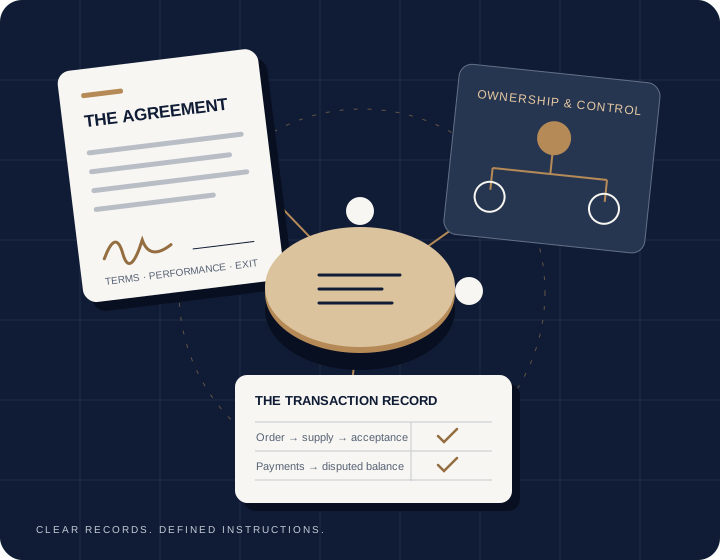
Start with your situation
What needs your attention?
You do not need to identify the court or name a remedy before contacting us. Begin with the decision your business faces.
The Commercial & Business practice
From the terms of a deal to the defence of your position.
Some instructions call for careful drafting. Others need a response to a demand, an ownership assessment or prepared litigation. Define the problem first so that the work addresses the commercial objective.
Contracts & commercial decisions
Before signing, varying or ending an arrangement, understand the obligations you are taking on.
Contract review & drafting
Supply, service, distribution and other business terms need to reflect the actual deal. Identify performance standards, payment events, responsibility, exit terms and dispute arrangements.
Discuss the agreement you needBreach, termination & performance
A missed payment, defective supply or proposed termination can affect several rights at once. Bring the agreed terms and the complete performance record before choosing a response.
Assess the contractual positionPayments, recovery & disputed accounts
Separate what the books show from what the transaction record supports.
Unpaid invoices & business dues
Review orders, deliveries, acceptance, payments, credit notes and contested adjustments. Consider the proposed debtor, available evidence, route and practical recovery position together.
Discuss the payment recordResponding to a demand
If the claimed balance is wrong, identify each disputed item and the supporting records. Supply failures, returns, payments and agreed deductions need a clear explanation.
Prepare a responseMSME & banking route assessment
An eligible MSE delayed-payment reference and a secured-lending dispute do not follow the same procedure. Bring the registration or banking documents and the actual notice.
Identify the appropriate routeOwners, partners & business continuity
Clarify whose rights are affected, who can instruct and what must be decided.
Partnership & shareholder disagreements
Ownership, accounts, management authority, access and exit may raise different questions. Start with the entity documents, agreed rights and the specific act being challenged.
Discuss the ownership issueFounder and family ownership planning
Consider personally held business interests alongside family assets. Preserve the distinction between ownership succession and management authority.
Explore estate planning for business founders and familiesDispute resolution & representation
A prepared claim and a prepared defence both begin with the record.
Commercial litigation
Explore representation for contested business disputes, including forum assessment, mediation, preparation of the case and the next procedural stage.
Explore commercial litigationNegotiation & settlement review
Test the proposed payment, release, delivery, security and completion terms. A workable settlement should say who does what, when and what follows if the terms are not met.
Discuss a proposed settlementFor ownership planning, see estate planning for business founders and families.
The first assessment
Look beyond the amount demanded.
A large balance, a signed contract or a strong sense of unfairness is only part of the picture. An initial assessment should connect the right being asserted with the available evidence and the result you need.
- Whose right?
- Identify the client, contracting parties, authority to instruct and the legal interest affected. A company and its owner may have different positions.
- Which record?
- Compare the terms with performance, acceptance, complaints and payments. Include the material that the other side is likely to rely on.
- What result?
- Payment, performance, an exit, continued trading or protection of control may require different work. Consider the practical effect of each option.
The strength of the case, likely expense, business interruption, settlement options and enforcement position all matter. A favourable order does not itself establish that the other side can pay. These questions should inform the scope of the proposed work.
Choose the route after the facts
The right forum is part of the strategy.
The transaction, relief, value, territory, dispute clause and applicable statute shape the route. Your office address alone does not decide where proceedings belong.
- 01
Advice, drafting or negotiated terms
Identify the decision and whether document review, a response or settlement work can address it. Define the limits of any first instruction.
- 02
Commercial court or arbitration assessment
Check the nature of the dispute and the contractual arrangement before choosing proceedings. Where section 12A applies to a non-urgent commercial suit, pre-institution mediation must be exhausted.
- 03
A statutory or specialist forum
Eligible MSE delayed-payment claims and banking or company-law issues can raise distinct forum questions. Assess the particular documents and statutory conditions.
- 04
A case already in progress
Begin with the full pleadings, orders, service details and next date. Defence, interim applications, appeals and enforcement require their own stage-specific assessment.
Prepare for a useful consultation
Bring the transaction, not just the complaint.
A short chronology and organised documents make it easier to identify the real disagreement. Begin with what is available and identify anything missing.
The complete agreement
Signed terms, schedules, amendments, purchase orders, accepted quotations and dispute-resolution clauses.
The transaction and accounts
Invoices, proof of supply or performance, acceptance or rejection records, payments, returns and reconciled balances.
The parties and authority
Correct legal names, entity records, ownership or management documents and authority to instruct on behalf of the client.
The difficult correspondence too
Notices, complaints, concessions, settlement discussions and complete electronic records, including attachments and dates.
If proceedings have begun, add complete court papers, orders and the next hearing date. Agree a suitable confidential sharing method with the office before sending sensitive documents.
A defined engagement
Know what the next instruction covers.
A business may need one agreement reviewed or representation through a contested dispute. The scope should say which task is accepted and what requires a later instruction.
- 01
Identify the client and issue
Confirm the parties, conflicts, authority and the commercial decision. Bring urgent dates to the office’s attention immediately.
- 02
Agree the assessment
Set the documents, questions and work included. Identify any accounting, tax, technical or foreign-law input that needs separate coordination.
- 03
Confirm scope and fees
Clarify professional fees, court or other expenses, communication arrangements and the stage covered before substantive work proceeds.
- 04
Proceed on accepted instructions
Undertake the agreed task. Further negotiations, proceedings, appeals or enforcement may require an additional scope.
Fees should follow the work.
A contract review, negotiated settlement and contested proceeding involve different effort and responsibility. Ask for the inclusions and exclusions rather than treating one quoted figure as covering every future stage.
Local access · Appropriate jurisdiction
Business legal advice from Coimbatore, with your transaction in focus.
We coordinate instructions from Coimbatore, Tiruppur, Pollachi and the Nilgiris, alongside appropriate Tamil Nadu matters. Prepare the records relevant to your transaction and confirm consultation arrangements before visiting.
Coimbatore
Our consultation base for business owners, suppliers and authorised company representatives. Bring the contract and transaction trail so the discussion can focus on the decision ahead.
Legal services in CoimbatoreTiruppur
For a supply, job-work or buyer-payment concern, identify the parties, order terms, quality correspondence and delivery record. Overseas counterparties add questions about governing law and enforcement.
Legal services in TiruppurPollachi
For trading, service or family-business concerns, distinguish business accounts and contractual rights from the ownership of land or other family assets. Connected issues may need separate work.
Legal services in PollachiThe Nilgiris
For hospitality, service or premises-related business concerns, identify the operating entity, agreement and actual use of the property. The business dispute and property rights may require different analysis.
Legal services in The NilgirisOverseas owners and representatives
Start remotely. Clarify authority and local steps.
If you manage an Indian business interest from elsewhere, share the entity, your role, the issue and a safe contact method. Consultation, signing authority, document execution and appearances require separate consideration.
A foreign counterparty or cross-border transaction may need coordinated advice on governing law and enforcement. Where a matter requires Supreme Court representation, the firm coordinates through its Advocate-on-Record arrangement.
Discuss consultation arrangements30 questions · Six groups
Before you instruct a business lawyer.
Choose the subject closest to your concern. These answers explain the practice and initial assessment; the appropriate advice depends on your documents and circumstances.
Choosing your legal work
5 questions
01When should a business approach your commercial practice?
When a contract, payment, ownership decision or dispute needs legal assessment. Tell us the business involved, what has changed and the result you need. If a notice, summons or proposed termination carries a date, mention it at the start.
02Can I consult you before a dispute becomes a court case?
Yes. You can ask for a defined review of a proposed agreement, an existing commercial position or correspondence before taking the next step. Identify the decision to be made and the documents to be reviewed; the scope and fee are agreed before substantive work.
03Do you advise businesses defending claims as well as claimants?
Yes. Explain the allegation and send the complete notice or court papers through the agreed channel. A defence assessment should include the contract, performance record, payments, disputed entries and any possible counterclaim, rather than only the amount demanded.
04Is this practice only for incorporated companies?
No. Proprietors, partnerships, companies, business owners and creditors can enquire. The correct client and proposed parties must still be identified. A trading name, individual owner and incorporated company should not be treated as interchangeable.
05Do I need litigation or an advisory engagement?
That depends on the decision, the dispute and its stage. An agreement review or negotiated response may be the immediate task. If proceedings are being considered or have begun, our commercial litigation service covers assessment and representation through the relevant stages.
Contracts and payment concerns
5 questions
06What should I bring for an initial contract review?
Bring the complete agreement, schedules, amendments, purchase orders and relevant correspondence. Explain your commercial objective and any approaching signature, delivery or termination date. A clause cannot always be assessed sensibly in isolation from the rest of the arrangement.
07What makes a payment dispute ready for assessment?
A clear transaction trail: who ordered, what was supplied, when it was accepted, what became due and what was paid or disputed. Include credit notes, returns and adjustment entries. An unreconciled ledger balance should be identified as such.
08Can we discuss a dispute if there is no single signed agreement?
Yes. Share purchase orders, accepted quotations, invoices, delivery records, emails and messages showing the dealings. Their legal effect and evidentiary value require assessment; the absence of one signed document does not by itself answer every question.
09Should I share the other side’s quality complaints too?
Yes. Include rejection reports, service complaints, delayed-delivery allegations and your responses. Assessing a claim without the opposing explanation can conceal weaknesses, set-offs or settlement issues that will matter later.
10Can the first instruction be limited to a notice or response?
It can be scoped that way after assessment. Confirm whether the engagement includes document review, advice, drafting, dispatch and later negotiation. A notice is a defined step, not a promise of payment or an automatic extension of a legal deadline.
Owners, partners and continuity
5 questions
11Who is the client when a director contacts the firm?
That needs to be settled at the outset. The company, director, shareholder and promoter family can have different interests. Identify the proposed client, who has authority to instruct and whose interests the engagement will cover.
12What records help with a partner or shareholder disagreement?
Begin with the partnership deed or corporate constitutional documents, shareholder agreements, ownership records, relevant resolutions, accounts and correspondence. Explain the specific disputed act and whether a vote, transfer, meeting or exclusion is imminent.
13Can you act for both the business and an owner in a dispute?
Only if the proposed representation is appropriate after checking the parties and interests. Shared commercial history does not establish that interests remain aligned. The engagement should state clearly who is represented.
14Does planning a founder’s succession belong here?
Ownership planning connects with this practice, but our estate-planning page addresses lifetime arrangements for personally held assets and interests. Company-owned assets and management powers require separate consideration; a founder’s personal wishes do not alone settle corporate authority.
15Can an owner living abroad start the discussion remotely?
Yes. Provide your location, safe contact details, the entity involved and your authority or ownership interest. Remote consultation, signing documents and appearing in proceedings are separate questions. Any required local steps will depend on the actual instruction.
Choosing a route
5 questions
16Will every business dispute go to a commercial court?
No. The nature and value of the claim, territorial jurisdiction, contract and statutory forum must be examined. A commercial label or the fact that both parties are businesses does not settle the correct court or procedure.
17What if the contract mentions arbitration?
Share the complete dispute-resolution clause and related agreements at the start. The clause may affect the route and the role of a court. We assess the arrangement before recommending proceedings; the word arbitration alone is not a complete forum analysis.
18Will mediation be considered before a commercial suit?
For a suit covered by section 12A of the Commercial Courts Act that does not contemplate urgent interim relief, the prescribed pre-institution mediation process must be exhausted. A demand notice is not a substitute. The detailed litigation page explains this distinction.
19Is an MSME payment concern assessed differently?
Potentially. The delayed-payment framework for eligible micro and small enterprises may involve the Facilitation Council. Bring registration details, the transaction dates and supply records. The business label MSME alone should not be treated as proof of eligibility for a particular reference.
20Can a banking or recovery notice be handled as an ordinary invoice dispute?
Do not assume so. Identify the lender, borrower, guarantor, security, notice and relevant dates. Statutory banking remedies can have a different forum and procedure. Request an assessment of the specific notice before deciding the next step.
Urgency and the record
5 questions
21What information should I give first if there is a deadline?
Give the exact date, the document that states it and when it was received. Identify any next hearing, proposed termination or threatened change to assets or control. Ask about availability promptly rather than assuming an online enquiry has secured representation.
22What if negotiations are still continuing?
Share the negotiation record and the underlying claim dates. Ongoing discussions should not be assumed to protect every deadline. Ask for a separate assessment of any time-sensitive step while commercial discussions continue.
23Should I send only selected screenshots of business messages?
Keep the complete original conversation and attachments where available, including dates and participants. Selected screenshots may omit context. Agree a suitable sharing method; questions of authenticity, admissibility and production need their own assessment.
24What should I do with documents that weaken our position?
Preserve them and explain the context to your lawyer. Include concessions, complaints, part-payments and inconsistent correspondence. A useful strategy depends on an accurate record, not a selection of favourable documents.
25Can you guarantee immediate protection or recovery?
No. We can assess the facts, available route and proposed legal work. An enquiry or filing does not itself create a stay, secure assets or recover money. Interim relief, final success and actual enforcement are separate questions.
Consultation, locations and fees
5 questions
26Can I meet a business lawyer in Coimbatore?
Contact the office to arrange a consultation. The principal consultation base is in Selvapuram, Coimbatore; court-related appointments at the Gopalapuram litigation office are coordinated in advance. Confirm the venue before visiting.
27Can businesses in Tiruppur, Pollachi and the Nilgiris enquire?
Yes. Consultations are coordinated through the Coimbatore team, including an initial remote discussion where suitable. Give the location of the business, transaction and opposing party. Those details help assess jurisdiction and the practical work required.
28How are commercial legal fees agreed?
By the proposed scope and stage of work. A contract review, notice, negotiation and contested proceeding involve different tasks. Ask what the fee includes, which expenses are additional and whether later hearings, appeals or enforcement require a further engagement.
29Can our accountant or company secretary join the discussion?
Where appropriate and with the client’s authorisation. Accounts, tax issues and corporate records may need coordinated input. Clarify who may receive information and which professional is responsible for each part of the work.
30Does sending an enquiry appoint the firm?
No. The initial contact allows the office to understand the request, check availability and conflicts, and discuss scope. Representation starts only after acceptance of the engagement. For urgent dates, call and obtain clear confirmation of the next step.
Begin with the decision ahead
Tell us what your business needs to resolve.
Give the parties, transaction, location and outcome you are seeking. Mention a notice, hearing or proposed business change before describing the wider history.
Discuss your commercial or business matter
Ask about availability, the initial assessment and the proposed scope. Sending an enquiry does not by itself appoint the firm or protect a deadline.
Office and consultation details